

Published by Intelligent Office San Francisco
October 20, 2026
7 min
This is our 2026 update to Downtown San Francisco: Commercial Real Estate’s Post-Pandemic Recovery and Return-to-Office Trends, published in August 2025.
A year ago we described downtown San Francisco’s recovery as “real but fragile.” The third-quarter 2026 numbers show the recovery has gained ground. Vacancy has dropped sharply, leasing is on pace for a record year, and AI companies have become the biggest single source of new demand. Some things haven’t changed: hybrid work is still common, and attendance remains well below 2019. Here’s where the market stands as of October 2026, and what it means for small businesses and growing teams weighing their options in the Financial District.
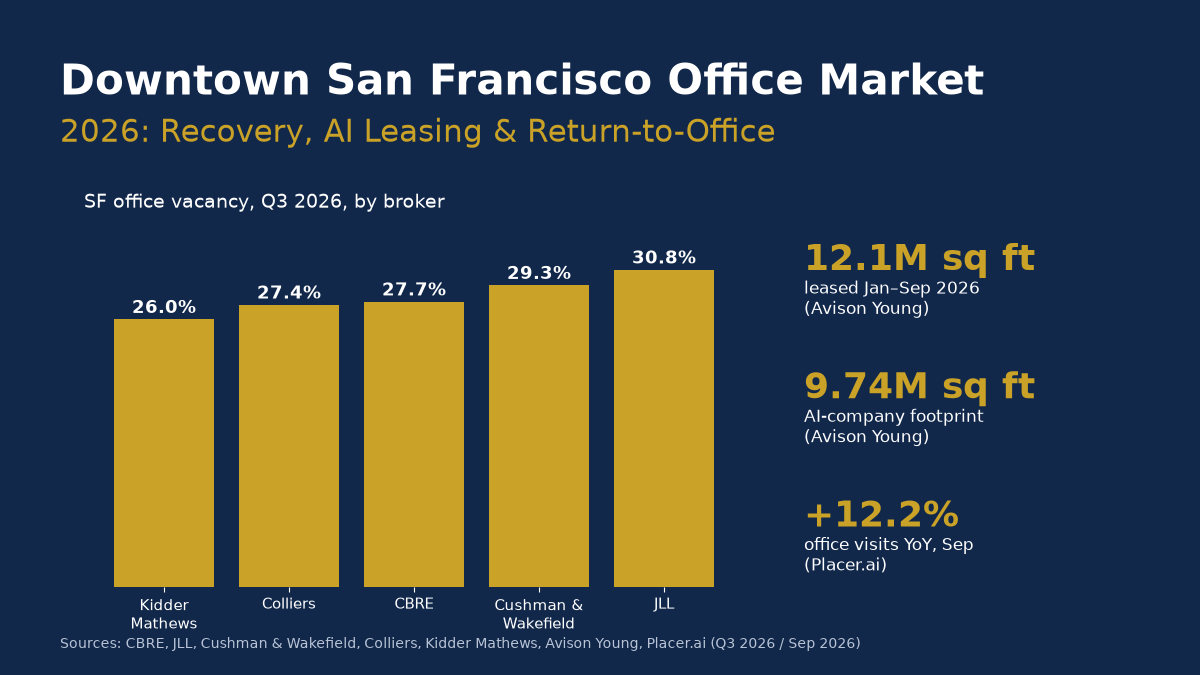
Each brokerage measures the market a little differently, so the headline vacancy rate depends on whose report you read. In Q3 2026 (the latest quarter available), every major report shows vacancy falling.
| Source (Q3 2026) | Overall vacancy | Notes |
|---|---|---|
| Kidder Mathews (CoStar data) | 26.0% | Down from 31.1% in Q3 2025 and a peak of about 32% in 2024 |
| Colliers | 27.4% | Down 370 basis points year over year |
| CBRE | 27.7% | 1.28 million sq ft of net absorption in Q3 |
| Cushman & Wakefield | 29.3% | Down 410 basis points year over year, the largest drop among U.S. markets it tracks |
| JLL | 30.8% | Broader market definition |

For context, our 2025 post cited a downtown vacancy peak of roughly 36.9% at the end of 2024. Measured on any of these scorecards, the market has moved several points in the right direction in a year. There is also no new office space under construction: Kidder Mathews and CBRE both report zero square feet in the pipeline, so incoming demand is absorbing existing space instead of competing with new towers.
Still, roughly a quarter or more of the city’s office space is empty. Availability also varies widely by neighborhood. Kidder Mathews puts it at 7.5% in Civic Center and 57.0% in Yerba Buena.
Avison Young reports 3.89 million sq ft leased in Q3 2026 and 12.1 million sq ft year to date, the highest January–September total it has on record. At that pace, 2026 could pass the 13.9 million sq ft leased in 2018. Kidder Mathews counts 10.0 million sq ft leased through Q3, up 33.8% from the same period of 2025.
Net absorption, the measure of occupied space actually growing, is just as telling. Kidder Mathews reports 2.75 million sq ft of positive absorption year to date, compared with negative 553,000 sq ft over the same months of 2025. CBRE puts its year-to-date figure at 4.5 million sq ft.
One detail matters for smaller firms. According to Kidder Mathews, nearly 60% of new office leases signed in 2026 were under 5,000 sq ft, and more than 75% were under 10,000 sq ft. Much of the recovery is coming from small, growing companies that want efficient, flexible footprints.
Last year’s post noted early signs of AI-driven leasing. In 2026 it is the main story. Avison Young estimates the total AI-company office footprint in San Francisco at 9.74 million sq ft in Q3 2026. That is 13.6% of all leased space in the market and a 37.1% increase from 7.1 million sq ft at the end of 2025. Preliminary JLL data reported by the San Francisco Business Times (Oct. 2, 2026) puts AI companies at about 10% of the city’s office space, the highest concentration in the country.
Recent large deals reported by Avison Young include Sierra AI’s renewal and expansion at 185 Berry St. (351,000 sq ft) and Cognition AI’s sublease at 333 Brannan St. (182,000 sq ft), alongside non-AI deals such as Amazon’s renewal and expansion at 525 Market St. (300,000 sq ft).
The flip side: Avison Young itself notes the market’s “dependency on an AI-driven recovery.” If AI funding cools, leasing could slow. Its own projection is that a steady 3–4 million sq ft of annual net absorption could bring vacancy below 10% sometime between 2030 and 2032. Even in the good scenario, a full recovery is years away.
Placer.ai’s September 2026 Office Index shows San Francisco office visits up 12.2% year over year, the strongest growth of any market it tracks (nationally, visits rose about 4%). San Francisco visits are still 33.8% below September 2019 levels. That is roughly where the city stood in our July 2025 snapshot (34.2% below 2019), so the year-over-year gains have not yet closed the gap with pre-pandemic levels.
Other measures tell a similar story:
The takeaway: employers, especially AI companies that want teams collaborating in person, are pulling people back downtown, but hybrid schedules are here to stay. Many workers still split the week between home and office.
On February 12, 2026, Mayor Daniel Lurie signed legislation creating the Downtown Revitalization Financing District. It pays eligible office-to-residential conversion projects an annual incentive for 30 years, funded by the future property-tax growth those projects create. The district covers the Financial District, Union Square, the Market Street corridor, the East Cut, Rincon Hill and Yerba Buena. The city projects about 50 buildings could qualify, yielding roughly 4,400 homes for more than 7,000 new residents. Projects can enroll through 2032.
The first wave is modest. Axios reported in July 2026 that three projects totaling roughly 300 units (901 Market St., 2300 Stockton St. and 150 Hayes St.) were expected to submit applications. Conversions won’t solve vacancy on their own, but they remove obsolete office space and bring more residents, and more weekday and weekend activity, to the downtown core.
The 2026 market sends mixed signals to a small business. Demand is rising, asking rents are firming (CBRE reports an average asking rate of $75.73 per sq ft per year in Q3 2026), and good space in well-located buildings is getting more competitive. At the same time, hybrid work means many teams don’t need a desk for every person every day, and a multi-year lease is a big commitment while the recovery still depends heavily on one industry.
That’s why the small-lease trend makes sense, and why flexible workspace is a practical way to be downtown without overcommitting. A few questions to ask:
Intelligent Office San Francisco is at 100 Pine Street, Suite 1250, in the heart of the Financial District, in a LEED-certified building one block from Embarcadero BART, the busiest of the downtown core stations. We offer coworking, day offices for up to three people, hourly offices, a 5-person meeting room and a 12-person conference room, all without a long-term lease. For businesses that need a downtown presence without the space, our virtual office services include a professional business address, mail handling and live phone answering Monday through Friday, 8:30 AM to 5:00 PM.
As the market keeps shifting, flexibility lets you match your workspace to how your team actually works and adjust as things change. Call us at 415-745-3300 to book a room or schedule a tour. We’re open Monday through Friday, 8:30 AM to 5:00 PM.
50+ locations across the U.S. and Canada! Open a Franchise Location 
