

September 1, 2026
6 minute read
Ask a solo attorney what their office costs and you will get a number for rent. Ask what it actually costs and the number climbs: utilities, cleaning, furniture, the receptionist, the conference room that sits empty five days a week, and the five-year personal guarantee you signed in year one of a practice you were still inventing.
For most small firms in 2026, that math no longer works. Neither does the alternative most reach for — home office plus coffee shop — because law is not like other professions: you have confidentiality duties, service of process to receive, and clients who occasionally need to sit across a table from you and cry.
Serviced offices sit in that gap.
This article is general information, not legal or ethics advice. Professional conduct rules vary by state — confirm anything here with your own bar association.
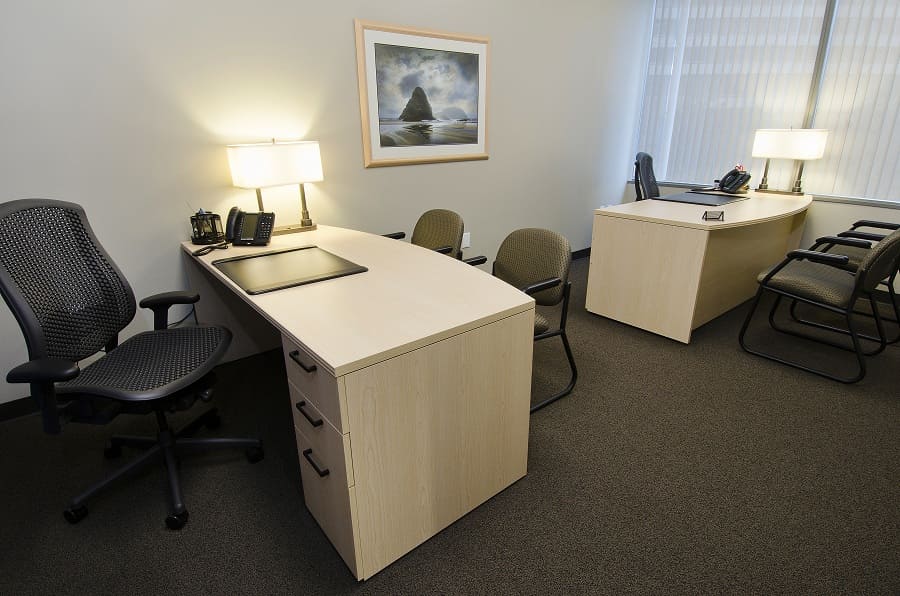
A serviced office is a private, lockable, furnished office inside a professionally managed building, on one monthly fee.
CBRE describes serviced offices as “professional environments, ready-to-use facilities, and adaptable contracts,” where “one monthly fee typically covers rent, utilities, cleaning, and reception services.” Hubble puts it plainly: it is “all set up and ready to go from the date you move in.” Once a stopgap between leases, it now prices as a destination product.
The distinction that matters most for attorneys:
| Traditional lease | Serviced office | Coworking | Virtual office | |
|---|---|---|---|---|
| Space | Bare shell | Private furnished suite | Shared floor | None |
| Term | 3–10+ years | 1–36 months | Monthly | Monthly |
| Deposit | 3–12 months | ~2× monthly rent | Usually none | None |
| Fit-out cost | Yours | None | None | None |
| Billing | Rent + CAM + utilities | One fee | One fee | One fee |
| Legal fees to sign | Yes | Typically none | None | None |
| Privacy | Full control | Private suite | Low | N/A |
| Meeting space | Yours | Allowance + bookable | Metered | Bookable |
Coworking is shared space; a serviced office is exclusive-use space with shared building services — for a law firm, a defensible confidentiality posture versus a problematic one.
In July 2023, the ABA Standing Committee on Ethics and Professional Responsibility issued Formal Opinion 507 on office sharing. It is permitted, but lawyers must take “appropriate measures to comply with their ethical duties concerning the confidentiality of information, conflicts of interest, supervision of nonlawyers and communications.” Read the safeguards it names as a shopping list:
A private suite satisfies most of that list structurally. A locked door, an inaudible conversation, a workstation nobody else uses, a filing cabinet only you open — architecture, not discipline. On an open floor, you compensate behaviorally, all day.
Opinion 507 also clarifies that office-sharing lawyers are not automatically one firm for conflicts purposes under Rule 1.10, though the analysis “will ultimately turn on specifics of the office-sharing arrangement.” Shared staff with access to two adverse clients’ files pushes it the wrong way. Keep your conflicts system firm-exclusive.
And Model Rule 5.3 extends to the operator’s staff. If a receptionist answers in your firm’s name, opens mail, or signs for deliveries, you supervise their confidentiality practices. Document that in the license agreement.
Per the ABA’s 2025 Profile of the Legal Profession, there are 1,374,720 active U.S. lawyers, and roughly 40% of U.S. law firms are solo, with more than 75% under six attorneys.
Clio’s 2025 Legal Trends for Solo and Small Law Firms found rent runs about 7% of expenses, plus 6–11% in office costs. The more telling finding is behavioral: 79% of solos and 81% of small firms run cloud practice management and 80% use video conferencing. The modern small firm is already portable. What it lacks is not software. It is a room.
Law remains the most office-committed profession. Cushman & Wakefield reported law firms leased 4.6 million square feet in Q1 2025, up 25% year over year, and 56% expect attorneys in-office three days a week, versus 26% in tech. CBRE’s 2026 survey found talent and workplace experience now outrank cost savings.
Supply has followed: flexible space is now 2.34% of U.S. office inventory across 9,384 locations, per CoworkingCafe’s Q2 2026 report, at a median $219/month per desk.
Plenty of marketing claims clients will not hire a lawyer without an impressive office. Servcorp’s guide for lawyers asks: “would you visit a lawyer if their address was their house? Or a P.O. box?”
The data disagrees. Clio’s Legal Trends research found home versus commercial office scores 1 out of 100 on the hireability scale, 35% of clients prefer virtual meetings against 28% in-person, and 59% of solo and small firm leads come from referrals. Trust transfers socially, not architecturally.
So make the real argument. A serviced office earns its cost four ways:
That is a defensible case. “Clients will judge you” is not.
A fully serviced executive suite bundles a private office, business address, mail handling, live reception and phone answering, and meeting rooms into one fee. Often the reception layer matters most: a receptionist who answers in your firm’s name, screens intake, and books consultations replaces a hire.
Before you sign:
Test the acoustics physically. Have someone speak at normal volume inside the suite while you stand outside the closed door. Ask whether walls run slab-to-slab, and confirm booths and meeting rooms are truly enclosed. Almost nobody does this.
Get service of process in writing. Will staff accept service? How is it logged and escalated? Many operators’ terms disclaim responsibility for legal process. A summons in a mail slot is a malpractice event.
Ask how mail is handled. Who opens it? Can you require unopened forwarding? What are the retention and post-termination policies? Client mail opened by a third party implicates Rules 1.6 and 5.3.
Probe shared infrastructure. Operator Wi-Fi, printers that store jobs, and after-hours cleaning access are real exposure. Use your own VPN and on-site shredding.
Check meeting room economics. Rooms are usually metered beyond an included allowance; if you meet clients weekly, model that cost.
Remember it is a license, not a lease, so you get fewer tenant protections. Read the termination, renewal, and escalation terms, and tell your malpractice carrier.
Confirm your state’s rules. Some jurisdictions have or had bona fide office requirements; New York’s Judiciary Law § 470 is best known, with repeal pending. ABA opinions are persuasive, not binding. Your state bar governs.
Is a serviced office the same as coworking?
No. A serviced office is a private, exclusive-use room with shared building services; coworking is shared space. Opinion 507 asks lawyers to avoid discussing cases in common areas and keep separate waiting areas — which a private suite meets structurally.
Can I use a serviced office address as my firm’s official address?
Often yes, but confirm your state bar accepts it as your address of record and that the facility can receive service of process — the test the NYC Bar’s Formal Opinion 2019-2 framed. Get that in writing.
Does sharing a building waive attorney-client privilege?
No. Privilege turns on a reasonable expectation of confidentiality, so the exposure is a conversation audible to strangers, not the building. Private suites and enclosed meeting rooms resolve it.
What about conflicts of interest if another attorney uses the same building?
Opinion 507 is clear that office sharing does not automatically impute conflicts between unaffiliated lawyers. Risk comes from shared systems — staff taking intake, a shared file system. Keep your conflicts database firm-exclusive and disclose adverse representations in the same suite.
How much does a serviced office cost compared with a traditional lease?
Headline rates vary by market; total cost is what matters. Serviced space bundles rent, utilities, cleaning, internet, furniture, and reception, with no fit-out, a two-month deposit rather than three to twelve, and no lease review fees. Over two years, the all-in comparison usually favors it.
Do I need a full-time private office, or would a virtual office work?
It depends on meeting volume. If you meet clients occasionally, a virtual office — address, mail handling, phone answering, bookable meeting rooms — may cover you. Weekly meetings, physical files, or firm-controlled space point to a private suite.
Can the receptionist answer the phone in my firm’s name?
Yes. With custom phone answering, local receptionists answer in your firm’s name, follow your intake script, screen calls, and book consultations. Under Rule 5.3 you still supervise that work, so document your instructions in writing.
A small firm does not need a five-year lease to operate like an established practice. It needs a private space where confidential conversations stay confidential, an address that can receive service of process, a room for the meetings that matter, and someone answering the phone while you are in court.
Intelligent Office has more than 50 locations across the U.S. and Canada, with private offices, client-ready meeting rooms, local receptionists, and mail handling on flexible terms.
Find Your Location and tour a space near you, or see what executive suites include.
50+ locations across the U.S. and Canada! Open a Franchise Location 
