

Published by Intelligent Office San Francisco
October 6, 2026

If you’re looking for office space for one person, the right choice depends on more than finding a desk behind a door. Consider how often you need a quiet place to work, whether clients visit, what meeting space you might need, and how much flexibility matters as your business changes.
For solopreneurs, consultants, lawyers, and remote professionals, a private workspace can separate work from home and give client meetings a more professional setting. But a full-time office is not the only option. A private office, day office, coworking membership, or virtual office may suit different schedules and needs. This guide offers a practical way to compare them—whether you work in San Francisco’s Financial District or serve clients across the Bay Area—without assuming that one format is right for everyone.
Before comparing locations or providers, write down what a typical work month looks like. A workspace used for focused work five days a week has different requirements from one used mainly for occasional client appointments.
Ask yourself:
Be specific. “I need a professional office” is a starting point; “I need a quiet place for calls three days a week and a meeting room twice a month” is more useful when asking questions and comparing options.
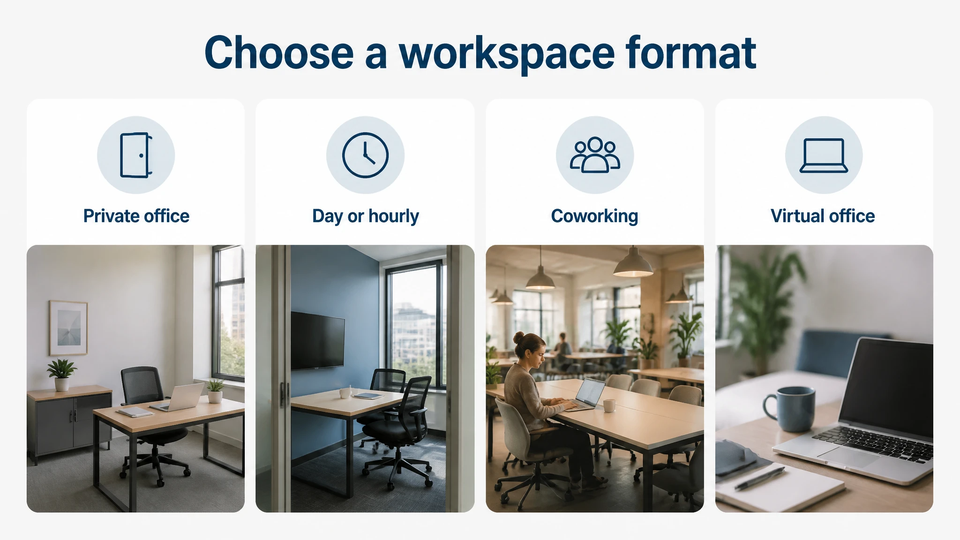
Match the workspace format to how often you need a desk, privacy, or meeting space.
A one-person office can mean several things. The names and terms providers use may differ, so confirm exactly what access and services are included before making a decision.
A private office gives you a separate work area. It may be a fit if you need regular access, privacy for calls or client conversations, or a consistent place to work. Ask whether the office is dedicated to you, what access schedule applies, and whether meeting rooms are separate or part of the arrangement.
A day office or hourly office may work when you need a private room occasionally rather than every day. This can be useful for a planned client meeting, a focused work session, or a temporary need for quiet. Confirm how reservations work, what is available on your preferred dates, and whether the workspace suits the activity you have in mind.
Coworking can provide a shared work setting. It may be worth considering if you value working around other people or do not need a private room throughout the day. Ask about the available work areas, whether workstations can be booked by the day, and how the space handles calls, confidential conversations, and client visits.
If your main need is a business address or related support rather than a daily desk, explore virtual office memberships and ask whether meeting or office access is available separately. For a closer look at what to evaluate in that type of arrangement, see this San Francisco virtual office guide.
The useful comparison is not simply “private versus shared.” It is how often you need to be on-site, how much privacy your work requires, and which services you actually expect to use.
Privacy matters for more than concentration. A lawyer, consultant, or other professional may handle sensitive conversations, documents, or client information. Ask how a private office is separated from shared areas and whether you can speak discreetly. Do not assume that a shared workspace offers the privacy your work requires.
If clients visit, consider their experience from arrival through departure. Is the location practical for them? Is there an appropriate place to meet? Would a private office, a bookable meeting room, or another arrangement feel suitable for your appointments?
Think about the impression you want to create, but keep the decision grounded in your actual work. A polished client meeting space may be important even if you do not need a dedicated office every day. Conversely, if visitors are rare, regular access to a private room may be less valuable than flexibility.
A convenient address is only useful if it fits your work routine. Consider your commute, client travel patterns, and whether you need to reach the office at particular times. In San Francisco, compare options based on the routes you and your clients actually use rather than choosing by neighborhood name alone—a Financial District address is an advantage only if it works for the people who need to get there.
When evaluating a workspace, check:
If you serve clients across the Bay Area or work mostly remotely, you may not need to commute every day. In that case, access for occasional appointments, mail needs, or scheduled work sessions may weigh more heavily than daily proximity.

A short, needs-based process makes workspace options easier to compare.
Your workspace needs may shift as your client load, work schedule, or business grows. Before signing or booking, get the practical terms in writing. Ask about the length of the agreement, notice requirements, renewal options, access rules, and any separate charges that may apply. Do not assume that a flexible-sounding option has a particular contract term or cancellation policy.
It can help to compare the commitment with your expected use. If you need a private office most weekdays, consistent access could matter more than the ability to book by the hour. If your schedule changes often, ask how reservations and changes are handled. If you are still establishing your business, look for terms that make sense for your current stage and clarify what happens if your needs change.
A solo workspace decision may include services beyond the room itself. Separate what you need from what would simply be convenient, then confirm the details directly.
Meeting access: Ask whether meeting rooms are available, how they are booked, and whether there are limits or separate fees. If you meet clients regularly, compare the size and type of room you need—a small meeting room for a few people or a larger conference room—with the booking process. Ask whether any meeting room hours come with an office arrangement.
Mail handling: If you want business mail services, ask what address use is permitted, how mail is received—for example, through a private mailbox or a digital address—and how you are notified. Confirm procedures for packages and forwarding rather than assuming they are included.
Phone answering: If you want calls answered on behalf of your business, clarify how calls are handled, what information the service needs from you, and whether the arrangement fits your client expectations. Some phone answering options start with announce-and-transfer, while custom scripts are a higher tier, so ask which level matches your calls.
Administrative support: Ask which tasks can be supported, how requests are submitted, and what the scope of service is. Treat “administrative assistance” as a prompt for specific questions, not a promise that every task is covered.
For a business that works remotely, these services may be useful even when a full-time private office is not necessary. For a professional who spends most days on-site, they may be secondary to privacy, access, and meeting requirements.
Compare options by looking at how well each one supports your work, not by room size alone. List the recurring needs you expect to use, such as private work time, client meetings, business mail, or phone support. Then ask each provider to explain which of those needs the arrangement covers and what would be handled separately.
A simple comparison table can help:
| Factor | Questions to ask |
|---|---|
| Privacy | Can I work and speak privately when needed? |
| Use pattern | Does access fit how many days I expect to be there? |
| Client meetings | Is there a suitable place to meet, and how is it booked? |
| Location | Does it work for my commute and client travel? |
| Flexibility | What are the agreement, notice, and change terms? |
| Support | What mail, phone, or administrative tasks are included or available? |
| Total cost | What recurring and separate charges should I account for? |
Compare written answers, not assumptions. If two options seem similar, consider which better matches your routine and what you would actually use over a typical month.
Use these steps to narrow your choices:
For San Francisco professionals, the best choice is the one that fits both the work and the way clients reach you. Start with the practical questions: how often you need a private office, whether you meet people in person, and what support would make your workday easier. Then compare the location, access, flexibility, and service details directly with each provider.
Intelligent Office San Francisco, in a Class A building at 100 Pine Street in the Financial District, is one local resource you can contact to discuss flexible office options and check current availability. Formats a solo professional might compare there include dedicated private offices, day and hourly offices, coworking workstations by the day, and meeting rooms—a meeting room that seats five and a conference room that seats 12—that can be booked by the hour or day without a membership. Private office members receive two meeting room hours a month, and certain membership packages can include 24/7 access, so ask the team which details apply to the arrangement you are considering.
Share your expected schedule and the services you need, then ask which options may fit. Request clear details about terms and services before deciding.
It depends on your schedule and work. A private office may suit regular work and confidential calls, while occasional-use or shared options may fit less frequent needs.
It depends on the workspace and the privacy required. Ask how calls and conversations are handled, and consider a private room if confidentiality is important.
Confirm access, agreement terms, meeting-room booking, mail procedures, available support, and any separate charges. Ask for the answers in writing so you can compare options accurately.
Not necessarily. If you mainly need a business address, occasional private workspace, or a place to meet clients, ask about options that match those specific needs rather than assuming you need daily office access.
If a business address matters more than a daily desk, read Virtual Office San Francisco: What to Look For Before You Choose a Provider. If you mainly need a place to meet clients, see Meeting Room Rental in San Francisco: How to Choose the Right Space. If call coverage is part of the same decision, review Professional Phone Answering Service: What to Compare. For day-to-day admin help, read Virtual Assistants for Small Businesses: Services, Benefits, and How to Choose One.
Intelligent Office San Francisco is at 100 Pine Street, Suite 1250 in the Financial District (Class A). Hours: Monday–Friday, 8:30 a.m.–5:00 p.m. PT. Call 415-745-3300 or contact us online to discuss a private office in San Francisco, day or hourly office use, or coworking for your solo practice, consulting work, or small business—and ask the local team about current availability, access, meeting room hours, and terms.
50+ locations across the U.S. and Canada! Open a Franchise Location 
